



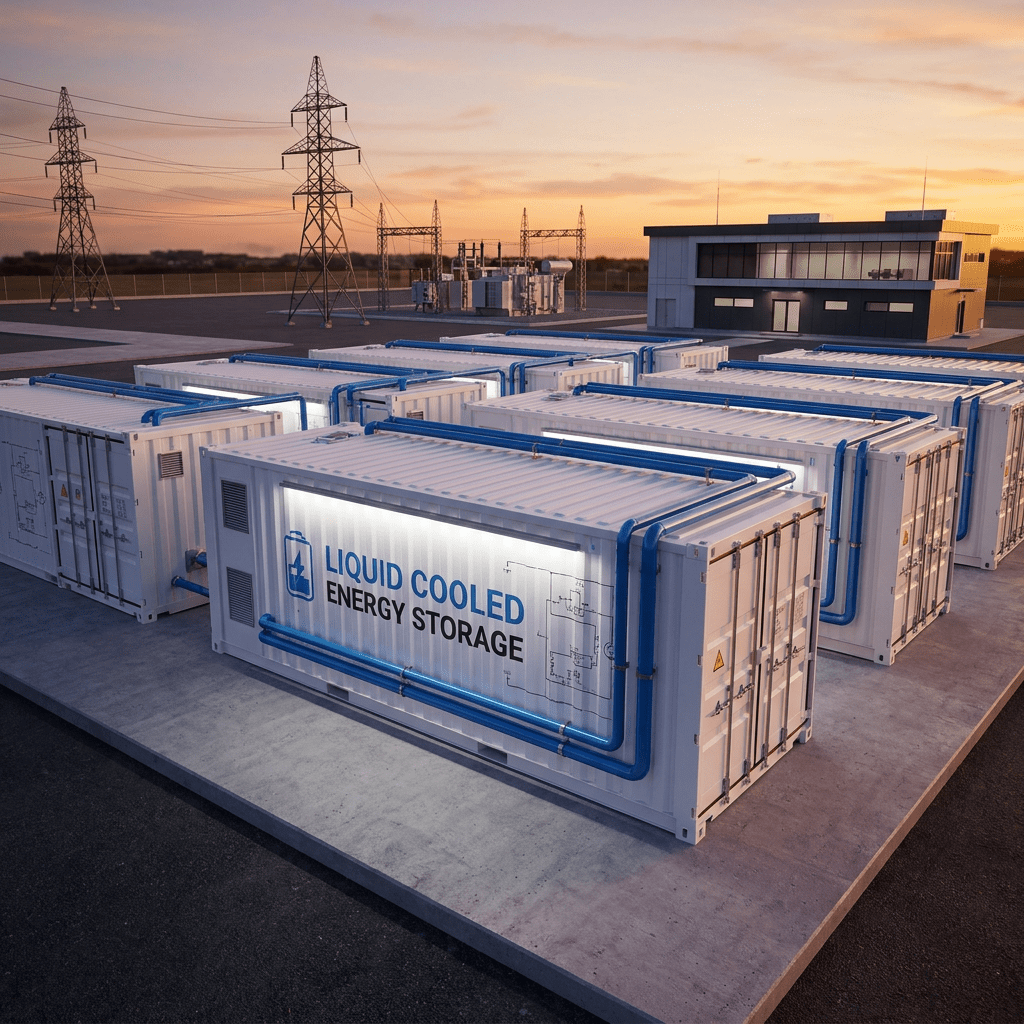
As global industries pivot toward massive-scale decarbonization, the demand for high-density, high-reliability Energy Storage Systems (ESS) has skyrocketed. For system integrators and utility operators, the choice of thermal management isn’t just a technical detail—it’s the primary factor in system lifespan, safety, and Return on Investment (ROI).
1. Air Cooling: The Traditional Workhorse
Air cooling has been the industry standard for over a decade. It utilizes high-velocity fans to circulate ambient air through battery clusters, relying on convection to dissipate heat.
Advantages:
- Simple Architecture: Lower initial complexity and hardware cost.
- Ease of Maintenance: Fans are standard components that are easy to replace in the field.
- Low Leakage Risk: Since no liquid coolant is used, there is zero risk of coolant leaks damaging battery cells.
2. Liquid Cooling: The High-Performance Leap
Liquid cooling uses a closed-loop system where a coolant (typically a water-glycol mixture) flows through cold plates in direct contact with battery modules.
Why Liquid Cooling is Winning in 2026:
- Precision Temperature Control: Liquid is up to 25 times more efficient at heat transfer than air. It can maintain cell-to-cell temperature differences within < 2°C, significantly extending the LiFePO4 cycle life.
- Space Optimization: Because liquid cooling is more efficient, battery modules can be packed more tightly, increasing energy density by up to 40% in the same footprint.
3. The StorXing Liquid-Cooled Solution
At StorXing, we have engineered our MW-class containerized ESS with a proprietary liquid-cooling stack designed for extreme reliability.
- Integrated BMS Handshake: Our BMS monitors cell temperatures in real-time, dynamically adjusting pump flow rates to match discharge C-rates.
- C4 Anti-Corrosion Enclosure: Our systems are rated for harsh industrial and coastal environments.
Ready to integrate high-performance storage into your next project?